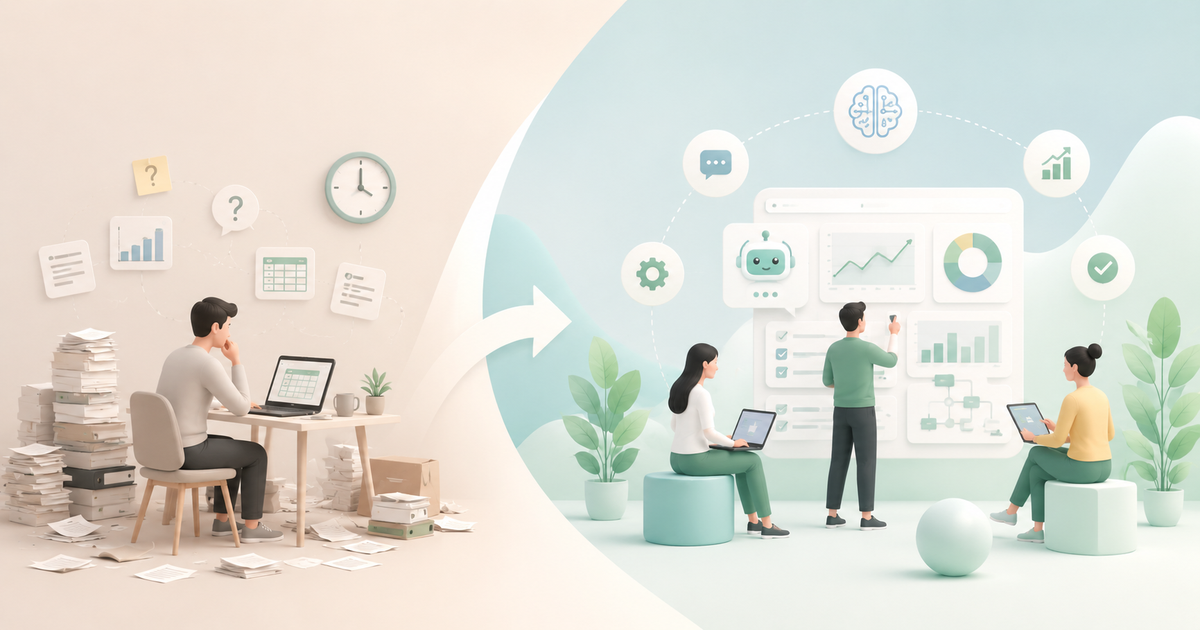
Imagine a customer calling you. You couldn't pick up, because you were busy behind the counter. By the time you call back, they've already bought from someone else. This is exactly where AI starts to matter for a small business: winning back that one lost customer.
When people hear "artificial intelligence," most business owners picture giant corporations, million-dollar budgets, and technology that's impossible to understand. But the reality today is different. AI has become a practical tool that makes daily life easier for the neighborhood restaurant, the ten-room boutique hotel, and the one-person e-commerce shop alike. In this guide, we'll set the hype aside and answer one clear question: Where and how does a small business actually use AI, and where should it begin?
What does AI really mean for a small business?
Let's clear up a misconception first. For a small business, AI isn't about robots, science-fiction movies, or a threat that replaces your employees. It's something much simpler: a helper that handles repetitive tasks for you, catches opportunities you'd otherwise miss, and keeps working even while you sleep.
Let's make that concrete. Think about the things you do every day but wish you didn't have to: answering the same questions over and over, trying to keep up with incoming calls, checking competitors' prices, editing product photos, keeping up with social media content. AI exists precisely to take over this kind of work. It frees you up to focus on the part of your business that actually matters: growth.
Why do small businesses fall behind? 3 common excuses
Almost every business that keeps postponing digitalization says the same three things. Let's take them one by one:
- "AI is expensive, my budget won't cover it." The truth is the opposite. Thanks to modular solutions, you can start small and use only as much as you need. What's truly expensive is the lost customers and wasted time.
- "It requires technical knowledge, we can't manage it." A properly designed solution is as easy to use as a phone app. You don't need to write code, manage servers, or build a technical team.
- "My business is small, this isn't for me." If your business is small, every minute and every customer is already more valuable to you. AI lightens the load the most for small teams.
What these excuses have in common is that they all rest on an outdated perception of technology. Yet the tools have changed fundamentally over the past few years.
Where exactly does AI make a small business's life easier?
Now we're at the heart of the guide. Each of the points below describes a real-world problem and its practical solution. See which one matches what you're dealing with in your own business.
1. Missed phone calls
Not being able to answer the phone during busy hours is one of the quietest ways a small business loses money. Every unanswered call often means a customer going straight to a competitor. An AI-powered phone assistant can answer calls 24/7; it can take appointments and orders, answer frequently asked questions, and bring you in when needed. Take a look at our AI Call Assistant solution, where we cover this in depth.
2. Visitors who leave your website without asking a question
A visitor lands on your site with a question in mind, but there's no one to ask, so they close the tab and leave. A smart support assistant answers the visitor instantly, guides them to the right product, and holds onto a potential customer instead of losing them. AI Support Engineer is built for exactly this, and it sets up in minutes without any code.
3. Finding out about competitor prices too late
Your competitor dropped their price and you didn't hear about it until days later. How many sales slipped away in the meantime? A tool that automatically monitors the market and competitor prices lets you see your position at all times and keep your prices competitive. AI Market Agent handles this tracking for you.
4. Sales lost to poor product photos
In online selling, the first impression is visual. A dark, cluttered, or amateur photo empties the cart no matter how good the product is. With AI, you can clean up backgrounds, create professional scenes, and produce marketplace-standard visuals in minutes. You'll find the details on the AI Product Image page.
5. No time for content and SEO
You know you need to produce content to show up in search engines, but you don't have the time for it. An AI-powered content assistant creates search-friendly, multilingual copy that highlights your products and services for you. AI Content Assistant takes this weight off your shoulders.
6. Industry-specific needs
Some challenges are specific to your industry. For a restaurant, having a menu that's accessible to everyone, including visually impaired guests, makes a real difference; KZ Restaurant delivers exactly that with its voice-enabled, multilingual digital menu. For a hotel, bringing reservations, guest management, and the website together in a single panel saves time; the AI-Powered Hotel Management solution was designed for this.
Tip: If, while reading the list above, there was a point that made you say "yes, that's exactly our problem," that's where you should begin. Don't try to do everything at once; pick the single point that's costing you the most.
Where to start? A practical 3-step path
The most common mistake businesses make when moving to AI is trying to digitalize everything at the same time. That usually ends with being unable to start anything at all. Follow a simpler path instead:
- Identify the process bleeding you the most. Pinpoint the single task that tires you out and costs you the most customers or money. For most businesses, this is either missed calls or unanswered customer questions.
- Test it with a small solution. Put a tool in place that solves that one process. Don't aim for a massive transformation; run a concrete trial.
- Measure the result, then scale. See the time and customers you gained. Once you've confirmed it works, move on to the next process.
This approach is no accident. It's the same path we follow in our digital transformation consulting: discovery and analysis first, then a roadmap tailored to you, followed by implementation and ongoing support.
3 common mistakes
- Trying to automate everything at once. It scatters your focus and you can't see any result clearly. Start from a single point.
- Trying to remove the human entirely. AI's job is to support you, not replace you. The best results come when you hand repetitive work to AI and keep critical decisions with people.
- Skipping data security and compliance. Any solution that works with customer data must be GDPR and KVKK compliant. This isn't a detail to think about later; it's a foundation that has to be built from the start.
Is AI really expensive?
Think of the cost question like the two pans of a scale. On one pan sits the price of the solution. On the other sit the losses you don't see: unanswered calls, visitors leaving without asking a question, competitor prices noticed too late, carts emptied because of poor visuals. In most businesses, the second pan weighs far more than the first.
What's more, a modular and scalable approach makes it possible to start small. Because you don't pay commissions to intermediary platforms, and your brand and earnings stay with you, the solution pays for itself over time. So the real question isn't "Can I afford it?" but rather "How much longer can I afford these losses?"
Conclusion: starting from the right place
AI is no longer a privilege reserved for big companies. Today, a small business can compete on the same field as its larger rivals by using the right tool in the right place. What matters isn't doing everything at once; it's choosing the single problem that challenges you most and starting there. Once you take that first step, you'll see how easily the rest follows.
If you're not sure where to begin, sometimes the right first step is simply a short conversation. Tell us about your business, and let's map out the best path together.
Frequently Asked Questions
Is using AI expensive for small businesses?
No. Thanks to modular solutions, you can start small and use only as much as you need. In most cases, the cost of lost customers and wasted time is far higher than the cost of the solution.
Do you need technical knowledge to use AI solutions?
No. Properly designed solutions are as easy to use as a phone app, with no need for code, server management, or a technical team.
Where should a small business start with AI?
The healthiest path is to identify the single process costing you the most time or customers and start there. This is usually missed phone calls or unanswered customer questions.
Are AI solutions GDPR and KVKK compliant?
They should be. Any solution that works with customer data must be built GDPR and KVKK compliant from the start. KobiZeka solutions are based on this compliance.